
By Marc Amat | November 27, 2026
Catalan composer, conductor and educator; Music Director of the Vancouver Symphony Orchestra.
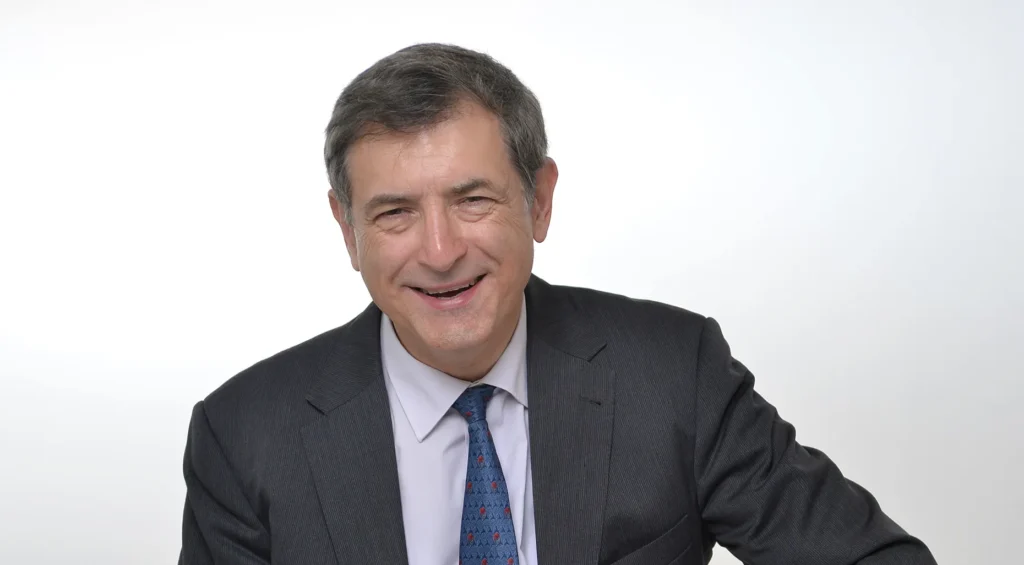
Composer and conductor Salvador Brotons (Barcelona, 1959) has spent more than four decades living with one foot in Catalonia and the other in the United States. Trained at the Barcelona Conservatori Superior de Música, he was awarded a Fulbright scholarship in 1985 that took him to Florida State University, where he earned a doctorate in music. The experience transformed both his professional and personal life. Today, he combines composing and teaching at the Escola Superior de Música de Catalunya (ESMUC) with conducting several ensembles, most notably the Vancouver Symphony Orchestra in Washington State, which he has led since 1991.
One of his compositions, 3 Nocturns alla Chopin, will be featured in“New Worlds: Music Between America and Europe”, a concert organized by the Institute of North American Studies (IEN) on November 5 at 6:30 p.m. in the Sala Oriol Bohigas of the Ateneu Barcelonès. Part of the Institute’s 75th-anniversary celebrations, the event explores the musical connections between both sides of the Atlantic through works by composers including Samuel Barber, Samuel Adler, Erich Wolfgang Korngold, Enrique Granados, Marc Migó and John Adams. The program examines how migration, exile and the exchange of ideas have helped shape American music.
Ahead of the concert, we spoke with Salvador Brotons about his musical roots, the influence of the United States on his work, and the cultural differences he has encountered throughout his career.
In 1985, you moved to the United States on a Fulbright scholarship. How did that opportunity come about?
My wife and I got married in 1983 when we were very young, and we started asking ourselves whether we wanted to spend our whole lives in Catalonia or experience living abroad. At the time, I had a great deal of work here. I was principal flute at the Orquestra del Liceu, second flute with the Orquestra Ciutat de Barcelona, and I was still finishing my studies at the Conservatory. But we were eager to leave.
As it happened, a professor from Florida State University came to Barcelona looking for music by European composers and became interested in my work. I told him that I wanted to study in the United States, and he offered me the chance to attend his university. My wife was also able to study music therapy there. We were very fortunate, and we ended up moving to Tallahassee.
Was it a major change from life in Barcelona?
 It was an incredible culture shock. We came from Barcelona and arrived in Tallahassee, a university town that was completely different. What struck me most was how open Americans were. I hadn’t managed to pass the English-language exam before leaving, but they allowed me to begin my studies on the condition that I would pass it later. They were extremely flexible.
That experience changed our lives completely. I always say that the most important thing that ever happened to me was moving to the United States.
What differences did you find between Catalan and American music education?
They were completely different systems. In Catalonia, I had received an excellent education, but it was very theoretical and not particularly practical. In the United States, everything was geared toward hands-on experience. If you wrote a composition, musicians would perform it almost immediately.
At the Conservatory here, you could write many works without ever hearing them performed unless you managed to gather a group of friends together. The same applied to conducting. In Florida, I spent two years as assistant conductor of the university orchestra, which was an extraordinary opportunity to gain practical experience. They also had facilities, libraries and resources that we could hardly imagine having here at the time.
What has the United States brought to you as a conductor?
The United States is my second home. It’s where I have been able to grow professionally and develop an orchestra over more than three decades. When I first began conducting the Vancouver Symphony Orchestra, it was a relatively small ensemble. Today, it has become one of the leading orchestras on the West Coast, and I’m very proud of that.
One of the most valuable lessons I’ve learned is the importance of connecting with the community. In the United States, audiences are essential to an orchestra’s survival. You have to know how to reach people, create engaging programs and make them feel part of the project. That relationship with the community is fundamental.
How has the American musical tradition influenced your compositions?

Profoundly. Before moving there, I was already familiar with and admired some American composers, such as Samuel Barber. But in the United States I discovered Aaron Copland and many other composers who made a strong impression on me.
All of that has influenced my search for a sound that is vibrant, powerful and communicative. I’m not especially interested in experimenting with things that are excessively abstract or unusual. I want music to communicate. I want contrast, and I want it to have an impact on listeners.
The music of Leonard Bernstein, Aaron Copland and Samuel Barber has always meant a great deal to me and has left a lasting mark on the way I compose.
How do you view the Catalan musical landscape today compared with the American one?
Catalonia has improved enormously. When I left in 1985, the differences were vast. Today, we have institutions such as ESMUC, better facilities and a much more comprehensive educational system.
Even so, I still miss the flexibility of the American model. There, students can choose a large portion of their coursework according to their interests and professional goals. Here, academic pathways remain too rigid.
There are also differences in the way orchestras are managed. In Catalonia, many institutions have guaranteed public funding, whereas in the United States you must constantly earn the support of audiences and the wider community. I’m very fond of that model because it forces you to maintain a genuine connection with the public.
Do you think there is a more open attitude toward different musical traditions in the United States?
 Without a doubt. I always tell my students that the United States is an extraordinary place to study music.
If you go to Vienna, you’ll find a magnificent musical environment, but one that is heavily centered on the Viennese repertoire. France also has very distinctive aesthetic traditions. In contrast, the United States offers just about everything. Many different traditions and approaches to composition coexist there.
If you have talent, you can be accepted regardless of your artistic style. I believe that openness is closely linked to the fact that the country was built from many different cultures. Personally, I have always felt very comfortable with that way of thinking.
The November 5 concert will include your 3 Nocturns alla Chopin. What can you tell us about the piece?
It’s a work I wrote in response to a commission connected to the commemoration of Chopin’s anniversary. I was asked to create a piece inspired by his style, so in this particular case the influence is much more European than American.
What I sought was precisely that dialogue with Chopin’s musical language.
The program also includes a work by Marc Migó. Marc studied with me and is an enormously talented composer. He has also been significantly influenced by American music and, to some extent, by my own work. He is highly dynamic and is successfully building a career in the United States. I’m delighted to be sharing the program with him.
The concert also features Samuel Barber, whom I consider one of the greatest American composers of all time, as well as other fascinating figures such as John Adams, whom I have had the opportunity to meet. Altogether, it offers a wonderful opportunity to hear a range of musical voices and to discover the connections between European and American musical traditions.