

By Núria Casas
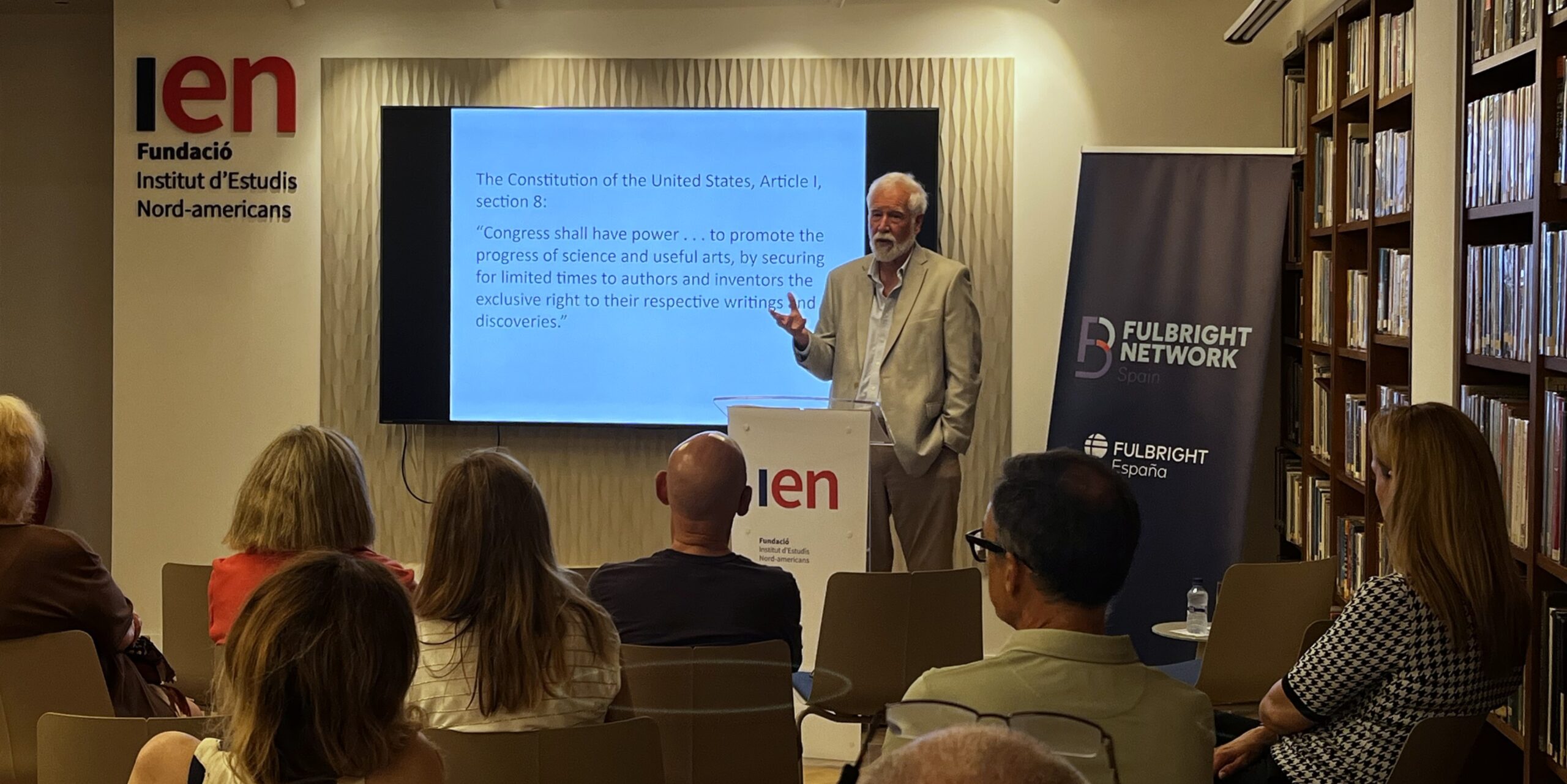
Professor Emeritus Dr. Ernest Freeberg delivers a keynote lecture at the IEN headquarters
The event was organized by the Institute of North American Studies (IEN) Foundation, the U.S. Consulate General in Barcelona, and Fulbright Network Spain as part of the activities commemorating the 250th anniversary of the founding of the United States.
There is a phrase that is repeated like a mantra. Without claiming originality, what people say is true: we must know the past to understand the present, a maxim popularized by the renowned scientist Carl Sagan. To this maxim, we can add the idea that if we understand our history, we can know how our future will be built. Because life is cyclical. Ernest Freeberg, Professor Emeritus at the University of Tennessee–Knoxville, delivered a lecture at the headquarters of the Institute of North American Studies in Barcelona that prompted us to reflect on this idea. Using the light bulb—one of the many inventions developed by Thomas Alva Edison—as a starting point, he explains how the United States, and Americans in particular, became a nation of inventors.
Invention as Culture
In his opening remarks, Freeberg presents a series of historical facts and developments that help explain the character of American society: “It was in the late nineteenth century that the United States began to become a nation of inventors. A second industrial revolution brought labor strikes, cities with ethnic conflicts, and pollution. But many people were optimistic and believed they were living in the greatest era for inventions: the telegraph, the telephone, automobiles. A world of wealth was emerging, and people began to see invention as a normal process.” This is the starting point established by the professor.
How Was the American Patent System Born?
Throughout the process, this transformation emerged from a collective instinct, but also in a somewhat accidental and organic way. Not even Edison himself, to use him as an example, fully understood it: “We usually associate a light bulb with wisdom and invention, although even the inventor himself did not realize it. In fact, he eventually held around 2,000 patents.”

Freeberg emphasizes this point during his lecture, portraying the period as a genuine technological revolution. Just as people were not fully aware of the short- and long-term consequences of these changes, there was also no structured vision of how to scale this ambition to keep creating and innovating: “At that time, there was not really an intellectual
class with academic training as we understand it today. By the end of the century, the United States was fascinated by new technologies. People wanted to change or increase their fortunes. They were obsessed with scientific pursuits and with creating practical improvements for everyday life—machines that saved labor, tools that reduced production costs, among other things.”
There was a genuine passion for scientific research and for creating practical improvements to everyday life. At the root of this movement was the patent system. It was not only a technological revolution but also a social and even anthropological one. The professor argues that it changed—or intensified—the American character through its obsession with progress and work. And beyond the light bulb, other inventions contributed to this trend. “The telegraph was a major step in that direction. The culture Edison helped create had a great deal to do with public education. There were no major universities, but education was accessible to everyone.”
Edison, Creator of True Innovation Factories
Edison’s life is a vivid example of how the American Dream was forged. He is remembered not only for the light bulb but also for a much broader system. He integrated existing devices but relied on a large team working in a country house, where he gathered physicists, chemists, and other specialists. In short: “He invented a new way of inventing, using the talents of different people to create a true innovation factory. His goal was to own the patents and be the first to achieve it”.
The other side of the coin was Thomas Jefferson, the third President of the United States from 1801 to 1809 and one of the nation’s Founding Fathers. In this story, however, his significance lies in the fact that he was the first administrator of the U.S. patent system and was responsible for reviewing the earliest patent applications as Secretary of State after the passage of the first modern Patent Act in 1790, long before becoming president. Ironically, Jefferson disliked patents. He believed they primarily benefited elites and felt that no one should own a patent. “Nevertheless, patents ended up spreading throughout the country, so while people could not copy them directly, they could draw inspiration from them. Now both men and women could profit from a good idea. Around 600 patents were registered, and the number increased rapidly within a few years.”
And What About Europe? Gaslight
At the same time, this transformation polarized American wealth and began shaping a geopolitical landscape more similar to the one we know today. It marked the rise of the New World in relation to the Old World. “The French, British, and Russians had been experimenting with another type of light bulb, but it did not work, so they returned to gas.” The professor continues: “Charles Brush developed something in 1877, and suddenly Broadway in New York was illuminated. There was a gigantic light in the middle of the city, like an enormous moon. The streets seemed safer, but people had to use umbrellas because the light was so intense that it gave them a ghostly appearance.”
Freeberg also delves into the details of how electric lighting gradually gained influence, not only in public spaces but also indoors. “Learning from the successes and failures of
Europeans, he developed the electric lamp, a non-combustion light source that prevented fires and accidents associated with gas lighting.”
From the Light Bulb to Today’s AI
The example of lighting is both metaphorical and literal. “American cities were more brightly lit than European ones. In Europe, by contrast, many cities were protected, making new construction projects more difficult”. This brings us back to the importance of the past in understanding the present. As discussed during the lecture, predicting the impact of artificial intelligence on different countries today follows the same pattern as the light bulb in the nineteenth century: the way invention is understood in each place, political support, administrative agility, and the determination of society.

Today, we find ourselves in the early stages of a similar transformation: the AI Revolution. Instead of powering engines and lamps, it drives large language models, autonomous systems, and digital platforms. But, like the first industrial revolution, its success or failure will depend on how organizational leadership manages three interconnected domains: governance, infrastructure, and human capital—the “Edisons” who will unlock AI’s potential. Beyond that, changes in attitudes and ways of life are closely tied to the inventions that emerge. Once again, the light bulb illuminates this conclusion: “Edison eventually distanced himself from the electrical system and contributed to the creation of work shifts. Night work exploited children and had to be regulated similarly to daytime labor.
At the same time, public spaces were transformed into colorful displays thanks to new lighting, and consumer culture emerged—for example, the famous Times Square in New York”. Reminding the audience that famous sayings are always worth revisiting, the professor also recalled one attributed to Edison: “Place an underdeveloped human being in an environment with artificial light and they will improve”. Although Edison did not foresee the social impact of his inventions or anticipate what was to come, the world was never the same again. And the United States, through him and other inventors, became the true cradle of the revolutionaries who transformed American society.