
By Bego Grau
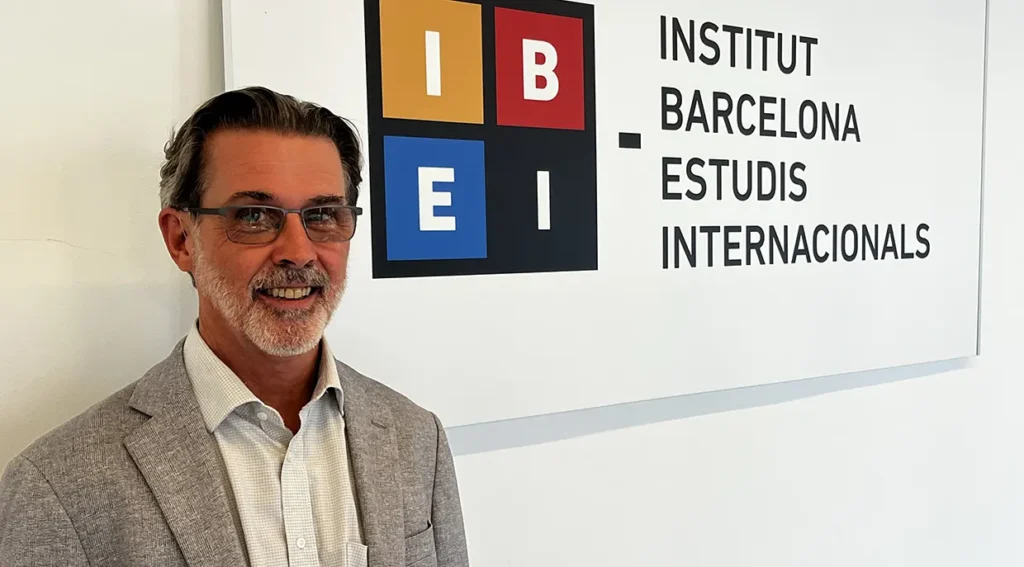
Security is often presented as the language of necessity, while human rights are framed as the language of limits. Jeffrey Davis, IEN-IBEI Research Professor and Senior Fellow at the Institut Barcelona d’Estudis Internacionals, works precisely at that intersection.
His academic profile is rooted in international law, human rights, and security studies, with a particular focus on how legal norms seek to constrain state power in contexts marked by fear, emergency, and political pressure. At IBEI, he teaches courses such as U.S. Human Rights in Comparison with Other Nations and U.S. Security and Counter-Terrorism, reflecting a research agenda that connects constitutional debates, counterterrorism policy, accountability, and the global erosion of legal standards.
His work offers a critical framework for understanding how states justify exceptional measures, how accountability is avoided, and why the struggle between means and ends remains central to contemporary international politics.
To begin, could you explain your main line of research?
My research is fundamentally concerned with the tension between power and principle; specifically, how human rights and broader international norms can become constraints on state security strategies. I look at both domestic and international landscapes, examining how governments justify deviations from these norms, particularly in areas like counterterrorism.
What motivates your research on this topic?
What interests me most is not only when violations occur, but how they are rationalized, normalized, and ultimately embedded into policy frameworks. In many ways, my work tries to understand why legal lits, that are meant to be binding, often become flexible when states perceive threats.
Do you think there is a growing tendency to prioritize political stability over justice?
Without a doubt —and I would actually take this a step further. It’s not simply political stability that is being prioritized, but a very specific and narrow conception of national and even self-interest, particularly in the case of the United States. Justice becomes secondary when it is perceived as inconvenient or costly. What we are seeing is not random, but a deep change where states treat the law as something optional when it gets in the way of their goals. That has profound implications, because once these norms are discarded by powerful states like the United States and Russia it invites others to do the same.
 How is this reflected in the international environment?
Over the last two or three decades, especially since the spread of the so-called “war on terror”, we’ve seen practices that would once have been considered exceptional become normalized. What’s particularly concerning is not just that these actions occurred, but that they were carried out with relatively limited consequences. This sends a powerful signal to other states: that international law can be, in practice, contingent rather than binding.
What impact does this have on trust, both politically and socially?
Trust is one of the first casualties of this shift, and its erosion operates on multiple levels. Internationally, alliances that took decades to build, especially between the United States and its European partners, have been deeply damaged. These relationships rely not just on shared interests, but on a belief in mutual reliability and respect for rules. When those assumptions collapse, rebuilding them is extraordinarily difficult.
And what are the internal consequences of this loss of trust?
Domestically, the consequences are equally severe. In a polarized system like the United States, where cooperation is already fragile, the breakdown of trust between political actors makes governance itself increasingly dysfunctional. It creates a cycle where distrust fuels inaction, and inaction deepens distrust.
Can that trust realistically be rebuilt?
I think it can, but not easily, and certainly not quickly. History shows that societies can recover from deep divisions, even from events as traumatic as civil war. However, recovery requires intentional political leadership committed to rebuilding institutional credibility rather than exploiting division for short-term gain. Trust cannot simply be declared; it has to be earned over time through consistent respect to norms and transparent governance. Without that commitment, any attempt at reconstruction will remain superficial.
What is the greatest threat currently facing human rights?
At the most immediate level, war remains the greatest threat because it represents the systematic breakdown of protections that human rights are meant to guarantee. But beneath that lies a more structural danger: the erosion of international norms themselves. Over time, as states violate these norms without facing consequences, a kind of learned impunity develops as governments begin to internalize the idea that these rules are optional.
What can this impunity lead to over time?
That process is particularly dangerous because it does not happen overnight. It is incremental, almost invisible, until the legal framework itself is fundamentally weakened. Over time, this creates a culture of legal unaccountability, where exceptional measures become normal political tools. The danger is that once this happens, the rule of law loses its authority precisely when it is most needed.
 Is it realistic to expect human rights to be respected in times of war?
War, by its very nature, is deeply incompatible with human rights. It represents a collapse, if not a rejection, of the very principles upon which human rights are built. While there are legal frameworks designed to regulate armed conflict, the reality is that the use of force almost inevitably leads to violations. Even so-called humanitarian interventions are fraught with contradictions, often producing harm that outweighs their intended benefits.
In the context of counterterrorism, what legal mistakes have been repeatedly made?
The most persistent mistake is the belief that sacrificing human rights enhances security. In reality, it often produces the opposite effect. When states abandon the rule of law, they undermine their own legitimacy. This, in turn, can fuel radicalization and create new security threats. There’s a kind of paradox at work: the measures taken in the name of safety can end up making societies less secure in the long run.
Do you think political leaders responsible for these trends will ever be held accountable?
Realistically, meaningful accountability is unlikely. While we sometimes see legal proceedings or political backlash, these rarely translate into real consequences. In some cases, even criminal convictions fail to produce significant consequences. This disconnect between wrongdoing and accountability reinforces the perception that power can operate beyond legal constraints. However, public opinion, elections, media and international control can be powerful tools.
Some argue the United States is reaching a point of no return. Do you agree?
I wouldn’t go that far. One of the United States’ strengths is its federal structure. While the national government may be moving in problematic directions, state governments retain significant autonomy and capacity for action. States like California, for instance, have the economic and political weight to pursue policies that counterbalance federal decisions, particularly in areas like climate change or social rights. This system of institutional resilience may slow or even offset national-level decline.
What alternatives to military approaches should be prioritized?
Strengthening international cooperation and legal institutions is key. The European experience, despite its imperfections, shows that sustained commitment to human rights norms can generate not only political stability but also economic and social prosperity. Moving away from coercive approaches requires rethinking security, not as dominance, but as cooperation and mutual reinforcement of legal standards.
 What role do NGOs play in this framework?
NGOs are absolutely essential. They are, in many ways, the lifeblood of the human rights system. Laws and treaties, on their own, are inert; they require actors to activate them. NGOs provide that function by translating abstract norms into action, whether through litigation, advocacy, or public mobilization. They also operate transnationally, building networks that can exert pressure across different political systems. Without them, human rights would remain largely theoretical.
What are the main challenges NGOs face today?
One of the most significant challenges is the growing tendency of states to frame NGOs as foreign or illegitimate actors. By labeling them as external influences, governments can justify imposing restrictive regulations and limiting their activities. At the same time, NGOs face chronic resource constraints, which makes it difficult to address the scale of global human rights challenges.
How does diversity shape the human rights debate in the United States?
Diversity in the United States is its greatest strength. However, it has always been one of the country’s deepest political and legal challenges. This is aggravated by politicians who exploit racism and other prejudices to gain political power. The U.S. has often presented itself as a defender of freedom and rights, yet its history shows a repeated tension between universal principles and racial exclusion. From slavery to segregation, the country has frequently proclaimed equality while denying it to large parts of its population. This means that the question of human rights in the U.S. is inseparable from race, inequality, and the difficulty of turning diversity into real equal protection under the law.
How should we understand the United States’ role in the international system today?
It’s increasingly difficult to view the United States as a singular global authority. Its position was shaped by post–World War II dynamics, but today we are clearly moving toward a more multipolar world, where power and legitimacy are distributed among multiple actors. In that context, the United States’ influence is not only declining in material terms, but also in terms of credibility.
In this fragile balance between power and principle, Davis’s work leaves us with a clear message: the future of human rights will depend on whether states choose to treat the law as a limit, or as an obstacle.