Photo: Borràs Camps

By Marc Amat
Director of the Sloan Kettering Institute in New York and a leading researcher in cancer research. Recipient of the IEN’s 2026 Kennedy Award.
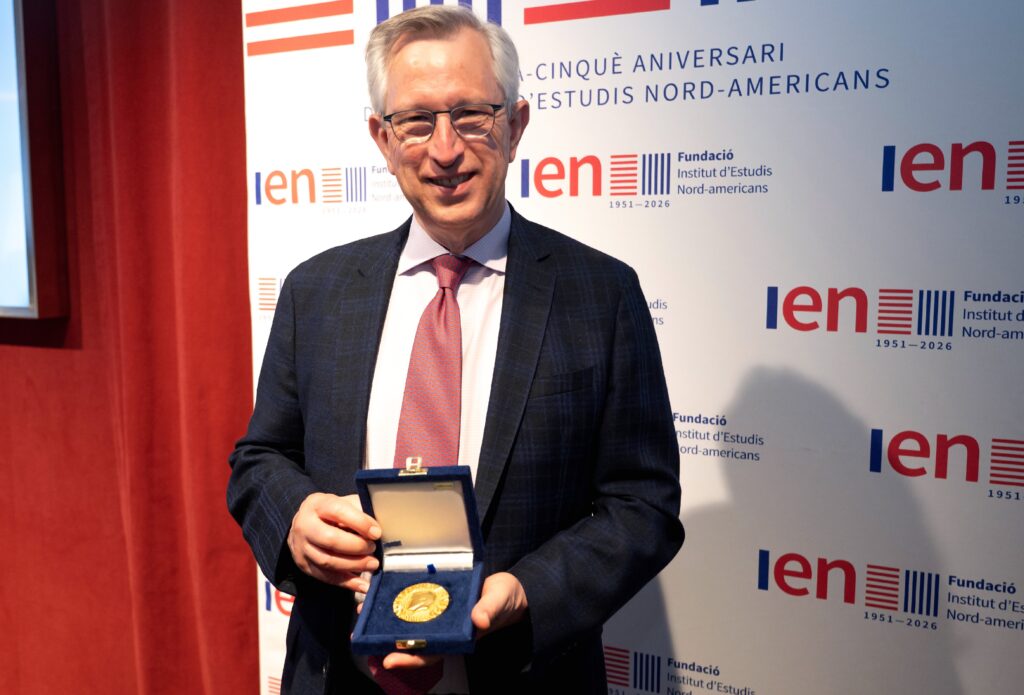
This year, Joan Massagué has been honored with the Kennedy Award, the Institute for North American Studies (IEN) prize that recognizes individuals and entities who have contributed to strengthening relations between Catalonia and the United States. The award, which is being reinstated to coincide with the organization’s 75th anniversary after a hiatus of several years, has honored figures such as Pau Casals, the crew of the Apollo 11, Valentí Fuster, and Xavier Trias throughout its history. In Massagué’s case, the recognition highlights a scientific career developed mostly in the United States, but always with links to Catalonia.
Born in Barcelona in 1953 and holding a PhD in Pharmacy and Biochemistry from the University of Barcelona, Massagué is one of the leading international figures in cancer research. He is currently director of the Sloan Kettering Institute in New York, one of the world’s foremost centers for oncology research. His research has been key to understanding the mechanisms of cell proliferation and metastasis, and has been recognized with awards such as the Creu de Sant Jordi (the Catalan government’s Cross of Saint George), the City of Barcelona Prize, the National Prize for Culture, the International Catalunya Prize, and the Prince of Asturias Award for Scientific and Technical Research.
On the occasion of the Kennedy Award, we spoke with him about his arrival in the United States, American scientific culture, his connection to Barcelona, and the role Catalonia can play in biomedical research in the coming years.
First of all, congratulations: you have been honored with the Kennedy Award. What does it mean for you to receive this award?
 It has been a great pleasure and a great honor. Especially because of the type of organization that awards it, and also because of the people and institutions who have preceded me throughout the award’s history. I think it’s a very generous gesture on the part of the Institute of North American Studies to create an award that recognizes people who have served as a link between these two cultures.
When did your interest in the United States begin?
In the 1960s, from a historical perspective, the United States was a myth. It was for my circle, for my family, as I think it was for many people and many circles. It was a technological and military power, but also a country of drama: the assassinations of presidents and candidates, the Vietnam War, Nixon’s controversial presidency… But despite all that noise, our overall perception was positive. It was seen as the country where the ideals of opportunity and merit were most recognized.
And in the scientific realm, what did the United States represent?
For those of us with a scientific inclination, as in my case, it was very clear: the United States was where the action was in every field: biology, biomedicine, engineering, chemistry… Europe might have its great exceptions to the rule, but the United States was the model to emulate. Therefore, if I was going to pursue a PhD in biochemistry, there wasn’t much debate about whether I should go to the United States or not. If you wanted to continue in research, it was natural to go there.
When you first arrived, what surprised you most about the way research was conducted in the United States?
I went to Brown University, one of the great classic universities on the East Coast. It wasn’t Harvard, MIT, or Stanford, but it was a wonderful institution where good research was being done. I got there thanks to my mentor in Barcelona, Joan Guinovart, who steered me toward Michael Czech’s group, which was working on a topic that was getting a lot of attention: the insulin receptor. In those days, everything was very much by word of mouth. My mentor would ask, you’d write a letter, they’d accept you if you got a scholarship… And I got a Fulbright scholarship.
And did you find what you were hoping for there?
 Yes. What I found fulfilled all my dreams and expectations when it came to the research facilities. It wasn’t that they were rolling out the red carpet, but compared to what we had here, it was another world. If it had been incredibly difficult for us to get a centrifuge here, there they had four; if reagents or supplies were needed, they could be bought. And I found, as has happened to me throughout my career, that what limited my ability to do research wasn’t the resources or the ideas around me, but my own limitations.
You must have also found a different scientific culture there…
Yes, and over time, I’ve come to see it even more clearly. I found a community very receptive to people who come from another country, with a strong accent and still-flawed English. It was a community that welcomed you and invited you to adapt. I also discovered the importance of mentorship, a concept that I’d never heard of in that way. It wasn’t just about having a good professor or a good lab, but someone who would guide you, challenge you, and help you stay on the right path of discovery and professional development. I was very lucky with Joan Guinovart here and with Michael Czech there.
What was your goal during that first stage in the United States?
 My goal was very specific: to publish at least one article in a journal that, from Barcelona, seemed impossible. I’m not talking about Nature or Science, but the Journal of Biological Chemistry, the JBC. At that time, for me, publishing in the JBC was like touching the sky. I published an article there. Then, four more. I felt very accomplished by that: I felt I had fulfilled my own expectations and those of my colleagues and my community.
So, was your intention to return to Barcelona?
Yes. I had gone to the United States because it was a natural part of my career path: get my doctorate here and then do a postdoc there. Also, the Fulbright scholarship stipulated that, after a maximum of three years, you had to return to your home country. My plan was to return to Barcelona and, most likely, work for a pharmaceutical or biotechnology company, or even at my family’s pharmacy. I didn’t think I would have a professional career in the United States.
But in the end you stayed. Why?
 Because I saw that, in the United States, I could do research in an environment where merit and scientific contribution really mattered. During my doctoral studies in Barcelona, I had seen how difficult it was, back then, to have a career based solely on the merits of being a researcher. I accompanied my mentor, Joan Guinovart, to an academic appointment process in Madrid: he did brilliantly, but he wasn’t given the position. When I expressed my surprise, he explained that the chosen candidate was “the one whose turn it was.” That really shocked me. I understood that, in the system, merit could be a secondary consideration. And I could work very hard, but I needed to do so in an environment where good work was possible and respected. My wife, Roser Salavert, was also very comfortable in her professional field of educational sciences. So we decided to stay in the US.
How have you seen Barcelona and Catalonia evolve as research hubs since then?
The United States has continued to be at the forefront of science and technology, but over time going there has stopped being the obvious choice. Many students have started doing postdoctoral work at good European institutions, in the United Kingdom, Germany, Switzerland, or other countries. And in Catalonia, especially Barcelona, an important phenomenon occurred: the governments realized they needed to invest in science and technology. Tourism, restaurants, and Michelin stars are all well and good, but they can’t sustain a country. Starting in the 2000s, new research institutions were created, often outside or alongside universities, with criteria of selectivity, excellence, and accountability. This allowed for a very important leap. Centers like IRB Barcelona, the CRG, ICFO, and IDIBAPS have placed Barcelona at a scientific level it did not have before.
You have described your career as a two-way bridge between Catalonia and the United States.
 Yes. To me, talking about a brain drain makes no sense. It’s a cliché that doesn’t explain, for example, my career path. I am an example of a two-way bridge. I went to the United States, conducted research there, developed a scientific career, and also learned a great deal about how scientific institutions are managed. And, after all these years, part of that knowledge has come back here. When the Barcelona Institute for Biomedical Research (IRB) was created, I was able to contribute to it not only from a scientific point of view, but also in the design and management of the institution: the structure, the doctoral programs, hiring, budgets, scientific and technical services… Then, interestingly, this experience in Barcelona also had an impact in the United States. When they offered me the directorship of the Sloan-Kettering Institute, they told me they were aware of what I had done in Barcelona. So the bridge has worked in both directions.
What role can Barcelona play in biomedical research and, specifically, in cancer research?
Barcelona has prestige and very important assets. In the field of cancer, there is the clinical research conducted at hospitals like Vall d’Hebron, there is basic research, and there is significant work being done in the study of metastasis. All of these are very valuable ingredients. But to take the next leap, what’s needed is coalescence: more connection between the parts, more decisiveness, and an overarching vision. The great institutions created 25 years ago have reached a good ceiling, but it is a ceiling. Maintaining it is already a challenge, but the opportunities to go further are real. They’re within reach in Barcelona with the right choices, a concentration of effort, and a commitment to doing a few things well and in great depth. In science, as in a collection, it’s not about having many paintings, but about having good ones that harmonize.
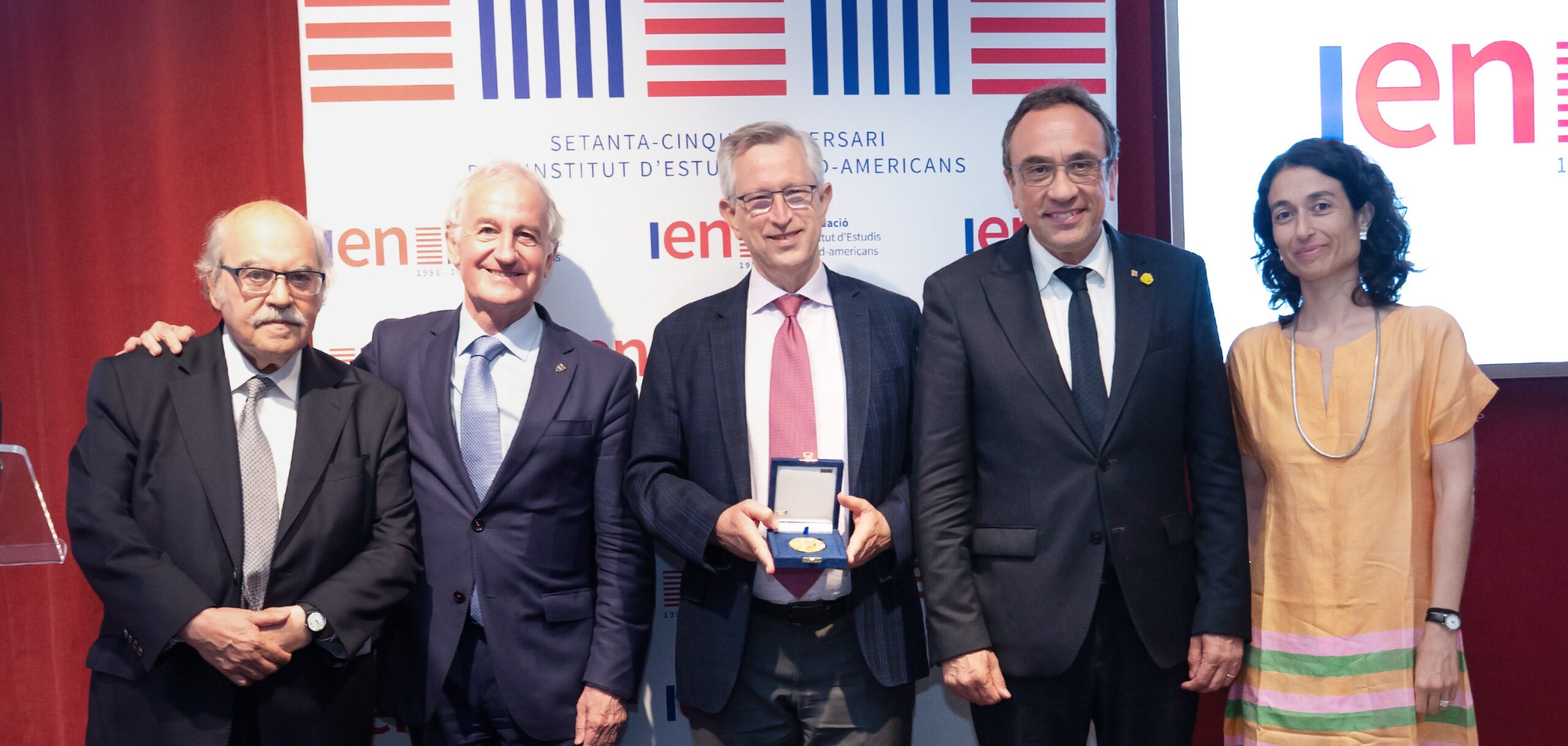
De izquierda a derecha:
Dr. Andreu Mas-Colell, Dr. Joan F. Corona. Dr. Joan Massagué, M. Hble. Josep Rull i Andreu y Dra. Caterina Guinovart.