The US Midterm Elections: Will Democracy Survive?
Chronicle of the event

As the United States approaches its 2026 midterm elections, the question turns over to what the electoral process itself reveals about the health of American democracy. At a time of growing political polarization, institutional tensions and declining public trust, the Fundación Institut d’Estudis Nord-Americans and Institut Barcelona d’Estudis Internacionals (IBEI) jointly hosted the conference “The US Midterm Elections: Will Democracy Survive?”, bringing together American and European perspectives on one of the most critical political elections of our time.
PANEL 1
American Democracy Under Pressure: Institutions, Elections and Civil Society
Journalist Xesco Reverter, member of the IEN Board of Trustees, TV3 journalist, and former US correspondent, opened the first panel by highlighting the international significance of developments in the United States. What happens in Washington extends far beyond American borders, raising questions that concern journalists, researchers, academic institutions and democratic societies worldwide.
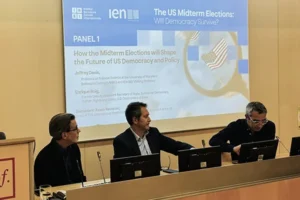
The discussion began with Jeffrey Davis, Professor of Political Science at the University of Maryland Baltimore County (UMBC) and IEN-IBEI Visiting Professor, who described the forthcoming elections as an unusually critical moment in American political life. His intervention focused on three structural weaknesses of the US electoral system: gerrymandering, the disproportionate representation of states in the Senate and the growing influence of money in politics.
Davis explained how partisan re-drawn of district lines can distort political and minority representation, pointing to controversies surrounding new electoral boundaries in states such as Texas. He also emphasized the unequal representation within the senatorial system, where states with largely different populations elect the same number of senators. Combined with the influence of wealthy donors, no matter the source of their funds, and political action committees, these features raise important questions about the relationship between electoral competition and democratic equality.
Turning to the electoral outlook, Davis noted that midterm elections have historically tended to disadvantage the president’s party. Nevertheless, he distinguished between the prospects for the House of Representatives and the more complex electoral landscape of the Senate.
His principal concern, however, went beyond the distribution of congressional seats. Allegations of electoral fraud, disputes over voting procedures and possible attempts to interfere with election administration could place additional pressure on public confidence in democratic institutions.
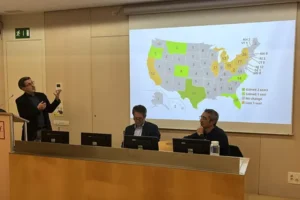
Despite these risks, Davis offered a cautious optimism about the resilience of American federalism. Because elections are administered primarily by state and local authorities, political power is diffused across multiple institutions, making centralized interference more difficult. Courts and state governments, he argued, remain essential safeguards, although their effectiveness cannot be taken for granted.
The discussion then moved from institutions to civil society with Enrique Roig, former Deputy Assistant Secretary in the US Department of State’s Bureau of Democracy, Human Rights, and Labor and former Vice President for External Affairs at Human Rights First.
Drawing on his experience in diplomacy and human rights, Roig expressed concern about what he characterized as democratic backsliding in the United States, particularly regarding pressure on independent institutions, civil society organizations, the media and legal professionals.
Yet, he also emphasized the growing mobilization of American civil society. Movements such as the No Kings demonstrations, alongside legal organizations challenging governmental actions, show different forms that democratic resistance can take.
Roig outlined three civic movement priorities: preventing immediate harm and defending democratic institutions, building bridges across ideological and social divisions, and developing a credible vision for democratic renewal. For him, protecting democracy requires more than opposing certain government policies, it also means strengthening accountability, documenting abuses and creating political alternatives able of responding to citizens’ everyday concerns.
This distinction became particularly relevant when Reverter raised the possible consequences of a Democratic victory. While congressional control could enable investigations, greater oversight and influence over federal expenditure, Roig warned that electoral success would not automatically mean effective governance. Political opposition must also offer solutions to economic insecurity and declining confidence in public institutions.
The discussion also addressed the role of misinformation and political polarization. Both speakers recognized the difficulties of communicating across increasingly fragmented media environments, where citizens often receive information from sources that reinforce their existing political convictions.
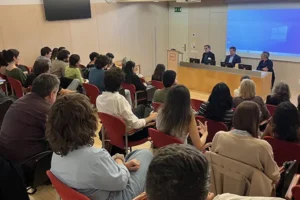
Questions from the audience broadened the debate to the consequences of American political developments for foreign policy, universities, scientific research and humanitarian assistance. Attention must be drawn to the human consequences of disruptions to international assistance programmes.
Davis concluded by referring to the commitment of younger generations, particularly students, whose willingness to participate in public life offered grounds for optimism.
PANEL 2
Beyond the United States: Citizens, Polarization and Democratic Recovery
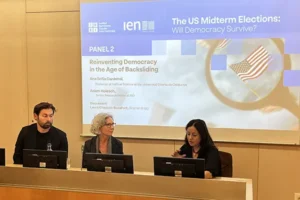
The second panel, introduced by IBEI Director Laura Chaqués, placed the American debate within the international challenge of democratic backsliding.
Ana Sofía Cardenal, political scientist and researcher at IBEI whose work examines political communication and democratic behavior, approached the discussion through a fundamental question: can citizens be trusted to defend democracy?
Her intervention explored the conditions under which voters recognize and sanction violations of democratic rules. For democratic accountability to function, citizens must first identify misconduct and then demonstrate a willingness to punish those responsible, no matter where it comes from.
Cardenal explained that these processes are heavily influenced by political information and the credibility citizens attribute to its sources. People frequently rely on parties, politicians, media organizations and other trusted actors to interpret political developments. Therefore, the same behavior may be judged differently depending on which political group is responsible.
She identified three mechanisms through which polarization weakens democratic accountability: perceptual capture, when citizens fail to recognize a democratic violation; the partisan trade-off, when they tolerate misconduct committed by their preferred party; and the subversion dilemma, when they justify questionable actions because they fear their opponents would otherwise do the same.
Particularly significant was her distinction between political polarization and what she defined as polarization of credibility. When citizens trust only information originating within their own political communities, the possibility of establishing shared democratic standards becomes heavily challenged.
This creates a paradox, as citizens are expected to hold political elites accountable, yet they often depend on those same elites to determine whether democratic rules have been violated.
Cardenal therefore cautioned against assuming that elections provide an effective democratic remedy. Their ability to produce accountability depends on whether voters are willing to apply the same standards to all parties, including when doing so challenges their own political preferences.
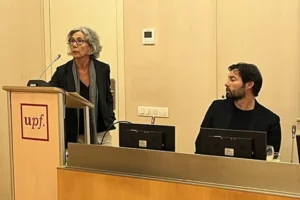
The comparative dimension of the panel was developed by Adam Holesch, a researcher at IBEI specializing in European politics, who examined democratic backsliding and recovery through the experiences of Poland and Hungary.
Holesch stressed that winning an election and restoring democratic institutions are fundamentally different processes, and the consequences of institutional reforms may persist long after a change of government. Hungary offered an alarming case, showing how the concentration of political influence over the judiciary, media, universities and other institutions can make a democratic shift particularly difficult.
From these experiences, Holesch identified several lessons relevant to the United States. Electoral rules, constitutional arrangements, opposition coordination and the mobilization of civil society all influence the prospects for democratic change. He also emphasized the role of conservative challengers and younger voters in confronting entrenched political movements.
He also argued that democratic backsliding cannot be understood simply through individual political leaders. The ideas, grievances and political identities, pillars to such movements, may persist even after those leaders leave office.
The final exchanges returned to the question of public trust. Cardenal stressed that messages condemning democratic violations are unlikely to persuade citizens who distrust their source. Rebuilding accountability requires communication capable of crossing partisan boundaries, instead of simply reinforcing existing divisions.
Throughout the conference, a central tension remained unresolved. American democracy possesses significant institutional protections, but their effectiveness depends on political actors respecting democratic rules and citizens recognizing when those rules are threatened. For Europe, the experiences of Poland and Hungary are a reminder that democratic erosion and recovery are not uniquely American or restricted to a particular political system.
As the United States prepares to vote, the midterms will determine the balance of power, but their broader significance lies in what they may reveal about institutional resilience, public trust and the willingness of citizens to demand accountability.
Democracy is exercised at the ballot box, but its survival depends on the institutions, principles and civic commitments that societies build long after the votes have been counted.