Midterms 2026: A Referendum on Trump
Chronicle of the event

The United States is approaching its midterm elections amid extreme political polarization, institutional tensions, and a shifting international order. As part of its ongoing electoral series, the Institute of North American Studies (IEN) brought together journalists Anna Bosch, former TVE correspondent in Washington, Moscow, and London, and Xavier Vilà, international relations consultant and former Catalunya Ràdio correspondent in Washington. The discussion, moderated by Xesco Reverter, a member of the IEN Board of Trustees, TV3 journalist, and former US correspondent, explored what is truly at stake in elections whose significance extends far beyond the distribution of seats in Congress.
Some elections are about choosing representatives, others become a judgment on the direction of an entire country. The 2026 US midterms appear destined to be both. Halfway through Donald Trump’s second and final term, Americans are preparing to head to the polls at a moment when political divisions are no longer simply about who governs, but also about how power is exercised, what limits constrain it, and which rules still apply.
This was the starting point of the conference, “Midterms 2026: A Referendum on Trump”, which invited participants to look beyond electoral forecasts and examine the health of American democracy and the international consequences of Trump’s second administration.
A blue wave, but not necessarily a tsunami
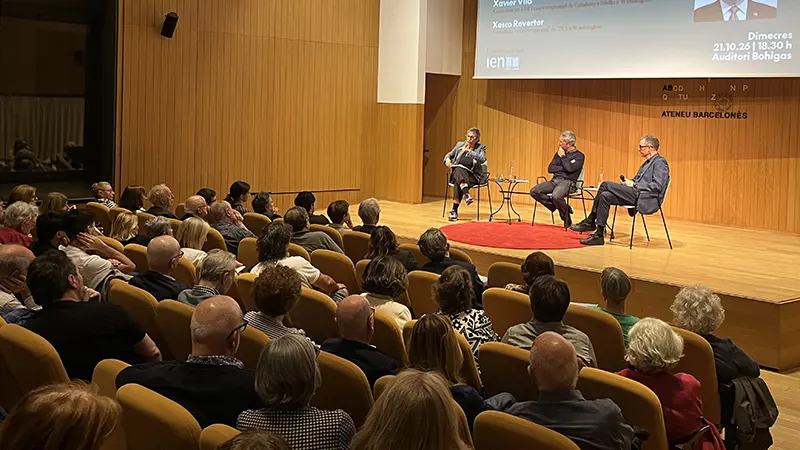
The first question was electoral: to what extent could Democrats regain control of Congress? Reverter opened the discussion by noting that some forecasts placed the Democratic Party’s chances of winning the House of Representatives at around 80%. Yet, as the discussion would demonstrate, numbers tell only part of the story.
“A wave, yes, a tsunami, no,” Vilà summarized, suggesting that a Democratic victory would not necessarily translate into a Republican collapse. Bosch recalled a recurring pattern in American politics, where presidents serving their second term often face electoral setbacks in midterm elections. Nevertheless, today’s polarization and the importance of competitive districts make any prediction particularly difficult.
The question is not simply how many seats Republicans might lose, but also which seats they might lose and how consequential those losses would be. What would such a defeat mean for a president who has made himself the gravitational center of his party? Trump himself has framed the elections as a referendum on his leadership. It is precisely here that the midterms transcend their legislative purpose and become a political test of his presidency.
The cost of living and the price of promises
If elections are often decided by voters’ wallets, this time the economy could become a particularly uncomfortable adversary for the White House.
Bosch recalled that Trump had built much of his presidential victory around a specific promise: restoring Americans’ purchasing power. Two years later, she argued, that expectation had not been fulfilled. Rising fuel prices and the difficulties facing rural communities threaten to generate dissatisfaction among some traditionally Republican constituencies.
Vilà exemplified this reality through the testimony of a farmer who complained about having to pay six dollars per gallon of fuel, a price that many agricultural businesses would struggle to afford. Faced with this discontent, Trump has resorted to promises of multibillion-dollar assistance packages, a strategy that, according to the journalist, reveals a troubling lack of fiscal responsibility and budgetary discipline.
The economic discussion also introduced one of the debate’s central paradoxes, how foreign policy, traditionally a secondary concern in many domestic campaigns, can directly influence voters’ decisions. Tensions with Iran and their repercussions for energy prices demonstrate how international decisions can affect the everyday lives of American voters.
Politics as an spectacle
The conversation then turned to one of the most distinctive features of the Trump phenomenon, his ability to transform politics into a permanent spectacle.
For Bosch, the president’s success cannot be understood only through his political proposals, but also through the image he has carefully constructed of himself. Trump has turned media attention into a form of power. Before being a politician, he is a communicator who understands the mechanisms of entertainment and knows how to exploit them with extraordinary effectiveness.
In this context, Bosch explained how Trump has proposed holding large-scale political conventions for the midterm elections, events traditionally associated with presidential campaigns, in an effort to capture media attention. She also recalled his promise to give every citizen $5,000 if Republicans retained their congressional majority. Such a promise blurs the boundary between political persuasion and the buying of electoral support, raising fundamental concerns about the very principles of democracy.
Reverter introduced another decisive variable, how the influence of campaign financing and the Republican movement’s ability to dominate the media landscape. Bosch, however, emphasized the gap between the president’s narrative and electoral reality. Trump claims an extraordinary popular mandate, yet his victory does not represent the majority will of American society as a whole.
The limits of power
One of the most unsettling moments of the discussion came when the speakers considered the possibility of a Democratic victory and the White House’s potential response.
The January 6, 2021, attack on the Capitol continues to cast a dark shadow over American politics. Bosch raised the possibility that, faced with unfavorable results, the administration might attempt to delay the certification of election results. Vilà added that certain forms of voter intimidation targeting minority communities, or challenges to mail-in ballots, could create an atmosphere of electoral conflict.
With a potential Democratic majority, Congress could launch parliamentary investigations, scrutinize members of the executive branch, and exercise its budgetary oversight powers. Nevertheless, Bosch recalled that Trump has already demonstrated a clear preference for governing through executive orders. A legislative defeat could, paradoxically, reinforce this tendency.
The question, therefore, was no longer simply whether Congress could restrain Trump, but something more fundamental: to what extent are American institutions prepared to contain a president determined to test their limits?
When the World becomes a stage
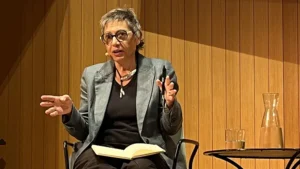
The possibility of losing legislative control opened a second major area of discussion, the future of American foreign policy.
Bosch suggested that a Trump facing greater domestic obstacles might intensify his international activity in an attempt to consolidate his legacy before leaving office. This could translate into a more aggressive policy toward Iran, renewed pressure on Ukraine, or a reassessment of the United States’ military commitments to Europe.
She warned of the risk that Washington might seek to negotiate Ukraine’s future directly with other major powers, sidelining both the country under attack and its European allies. Vilà, meanwhile, argued that the European Union must reflect on its strategic autonomy in defense matters and its actual capacity to act without relying on American protection.
The discussion then moved toward an even deeper question, the nature of Trump’s foreign policy. Bosch and Vilà highlighted the growing importance of economic interests and a transactional understanding of international relations, illustrated by US actions in Venezuela and pressure on Cuba.
Reverter, however, introduced an important aspect, that reducing Trumpism to a mere pursuit of economic gain risks overlooking its ideological depth. Unlike his first administration, he argued, Trump’s second term has increasingly developed its own worldview, driven by an ambition to reshape the existing international order.
Bosch captured this idea through a particularly striking image, a return to a world of empires, divided into three major spheres of influence led by the United States, Russia, and China. Under this conception of international order, each power would exercise authority over territories it considers part of its own sphere, relegating state sovereignty and the rules governing international relations to a secondary position.
A democracy on the edge of the precipice
The final part of the conference returned to a question that had hovered over the entire discussion: what is happening to American democracy?
Bosch recalled the admiration traditionally inspired by the United States’ institutional culture. Despite partisan confrontations, there had long been a shared respect for certain rituals, procedures, and limits on political power. Today, she argued, much of that institutional respect and dignity has faded.
This reflection led back to the Founding Fathers and their concerns with preventing excessive concentrations of authority. The system of checks and balances was born precisely out of a distrust of absolute power. Yet Bosch noted that this equilibrium has been weakened by Congress’s conduct and the current composition of the Supreme Court.
Vilà offered a powerful metaphor, how, for decades, American democracy had provided the reassurance of driving along a road protected by safety barriers. Today, by contrast, the feeling is one of traveling dangerously close to the edge of a precipice.
Even so, the journalist called for a degree of historical perspective. Trump has caused a profound deterioration in institutional trust and transatlantic relations, but the United States has weathered other turbulent periods.
Reverter was less optimistic. Following the attack on the Capitol, many observers had considered Trump’s political career finished. His return to the White House forces a reconsideration of that assessment and suggests that the MAGA movement is not merely a passing anomaly, but a political force capable of enduring beyond its founder.
The melancholy of Washington
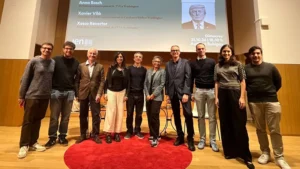
Questions from the audience provided an opportunity to address pressure on the media, the proliferation of information bubbles, and the Democratic Party’s strategic dilemma between maintaining a moderate approach and adopting a more confrontational stance.
The conference concluded with a reflection that seemed to unite all three journalists, a certain melancholy for the American democracy they had known, studied and admired.
Bosch acknowledged this shared sentiment, a nostalgia for Washington that does not imply idealizing the past, but recognize the growing distance between an institutional tradition and contemporary political practices. Reverter, however, offered one final reminder, that the United States is much bigger than Donald Trump.
Perhaps this is, ultimately, the central question of the 2026 midterms. The ballot box will determine who controls Congress, but it will also provide a measure American society’s capacity to respond to the political transformation it is experiencing.
For when a democracy is forced to ask whether its mechanisms of accountability still function, what is at stake is no longer the outcome of an election. It is the confidence in the rules that make elections meaningful in the first place.