5th US & EU Barcelona Meeting
2026. Securing Tomorrow’s Alliance: Re-imagining Transatlantic Security in a Changing World
March, 26th – 4.30–8.00pm
Auditori de La Pedrera, Passeig de Gràcia, 92, 08008 Barcelona
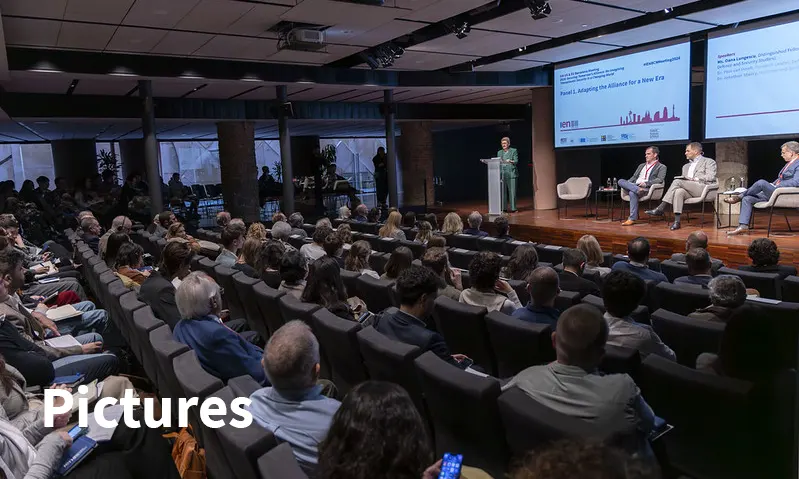
US & EU Barcelona Meeting 2026: New security landscape for Europe and the United States: from the future of NATO to the protection of knowledge
On 26 March, Barcelona’s La Pedrera building played host to the US & EU Barcelona Meeting 2026. Securing Tomorrow’s Alliance: Re-imagining Transatlantic Security in a Changing World. This fifth meeting took place amid the Iran and Ukraine wars, uncertainty about the future of NATO, increased defence spending, strategic pressure from China and the growth of hybrid threats in the military, knowledge, research, data and democratic resilience spheres. The event was organized by the Institute of North American Studies (IEN), in collaboration with the U.S. Consulate General in Barcelona, the European Commission Representation in Barcelona, the Institut Barcelona d’Estudis Internacionals (IBEI) and UOC’s Faculty of Law and Political Science, with the support of Fundació Catalunya La Pedrera, and brought together geopolitics, defence and security experts.
The conference was structured around two main themes: NATO’s adaptation to a new strategic phase and the need to safeguard knowledge, research, information and democratic societies in the face of increasingly complex risks. The talks had a clear common thread, focusing on a Europe with greater involvement in its own defence, redefining the distribution of responsibilities for the future of the transatlantic alliance, adapting to a landscape in which China is a key player, and broadening the scope of security to include the protection of knowledge and democratic resilience.
The president of the Institute of North American Studies (IEN) Foundation, Joan F. Corona, opened the conference by highlighting the IEN’s history as a bridge between Catalonia and the United States since 1951. As part of its 75th anniversary celebrations, he explained that the institution’s activities now revolve around three main areas: research and debate, European-American ties, and cultural life. “More than a conference, this is a dynamic exercise in diplomacy, reflection and cooperation,” he said. He described the US & EU Barcelona Meeting as one of the institution’s most important initiatives in the aim of bringing together academics, diplomats and professionals to address shared challenges such as security, democracy, technology and sustainability.
Manuel Szapiro, head of the European Commission Representation in Barcelona, gave a talk on the transatlantic security agenda from the EU’s perspective. Arguing that Europe must take on greater responsibility for its own defence while always acting within the framework of NATO, he proposed a broad concept of security encompassing energy, health, data, artificial intelligence, cybersecurity, migration, raw materials, finance, space and defence. “Our top priority as the EU is to protect our people,” he said. He summarized the EU’s strategic priorities based on three objectives – defending Europe, protecting our neighbours and diversifying alliances – citing tools such as the Readiness 2030 Plan, the Security Action for Europe (SAFE) programme and the AGILE programme for the acceleration of defence innovation. He also stressed the importance of supporting Ukraine, European expansion and stronger alliances with partners such as the United Kingdom, Canada, India and Australia.
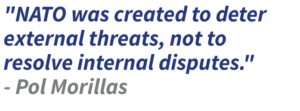 In his opening remarks, Pol Morillas, director of the Barcelona Centre for International Affairs (CIDOB), warned that transatlantic relations are currently at one of their lowest points ever in terms of mutual trust: “NATO was created to deter external threats, not to resolve internal disputes.” He believes that, rather than stemming solely from disagreements regarding capabilities or spending, the current crisis is also due to the gradual erosion of the political framework and of the values on which the alliance was founded. Warning that fundamental issues such as mutual defence, the shared perception of threats or the principles of consultation between allies are now being questioned, he argued that NATO cannot be reduced to investment percentages or national rearmament figures.
Panel 1: Adapting the Alliance for a New Era
The first panel discussion addressed NATO’s strategic options for the future ahead of the NATO Summit of leaders to be held in Ankara in July 2026. The discussion revolved around the division of responsibilities between Europe and the United States, the military capabilities to be prioritized by the Alliance, the role of nuclear deterrence and the response to an environment in which Russia, China and other emerging threats play a key role.
The discussion was moderated by Lluc Vidal, associate professor of Political Science and International Relations at the UOC, who framed the debate around three significant changes in the global landscape: the war between Russian and Ukraine, which has profoundly transformed European defence; the growing uncertainty surrounding the United States’ future in the Alliance – “the real question now is whether the US will remain in NATO” – and an Alliance that is increasing its spending and redefining its capabilities in a completely different environment from that of the Cold War. In his introduction, he highlighted that the debate on NATO is once again a central topic in public debate.

Jonathan Sherry, historian and senior editor at Eagle Intelligence Reports, focused on China as one of the factors forcing a rethinking of the Alliance. He said that expectations of Chinese economic integration leading to a political opening have not been fulfilled and that China has instead become strongly integrated into the global economy but with a more consolidated political system, significant government involvement in strategic sectors and rapid military development. Unlike the Soviet Union, an ideological and military rival that was relatively detached from the global system, China operates from within it. “The nature of the problem for which the Alliance was created has changed,” he said.

Oana Lungescu, a distinguished fellow of RUSI and former spokesperson for NATO, stressed that the Alliance has reached this stage with several support mechanisms: higher defence spending by European allies and Canada; new missions in the Baltic, along the eastern flank and in the Arctic; and closer cooperation with the EU, Ukraine and Indo-Pacific partners. However, she also warned that this additional support exists alongside contradictory messages from the United States and China, whose position should be considered in connection with that of Russia, Iran and North Korea. “Both our allies and our adversaries respect only one thing: strength.” She argued that Europe must become stronger for its own safety, as discussions increasingly shift beyond traditional burden-sharing towards a clearer assumption of responsibility for conventional defence by Europe.
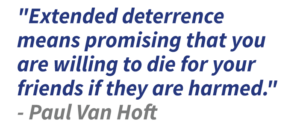
Paul Van Hooft, defence and security research leader at RAND Europe, approached the issue from a deterrence perspective. He noted that, at its core, NATO was a nuclear alliance founded on the credibility of the United States’ commitment to protecting Europe: “Extended deterrence means promising that you are willing to die for your friends if they are harmed.” He believes that the current problem reflects a deeper trend: the shift of the United States’ strategic focus towards the Indo-Pacific and China as a key priority. A reduction in the weight given to Europe in Washington’s calculations weakens the promise to protect it, forcing Europe to significantly step up in its own defence, not only in terms of spending but also in terms of strategic autonomy and concrete capabilities, such as long-range precision strikes, and integrated air and missile defence.
Panel 2: Enduring and Emerging Security Challenges
The second discussion shifted the focus from the military structure of the Alliance to new areas of vulnerability, with a particular emphasis on threats that extend beyond the traditional military sphere to include the realms of knowledge, research, information and data.
The moderator, Carme Colomina, a researcher specializing in European Union, disinformation and global politics at CIDOB, addressed the growing inclusion in security concerns of areas – ranging from universities and laboratories to critical infrastructure and digital platforms – previously seen as unrelated to such matters: “How can we prepare for cognitive warfare when the territory to be conquered is no longer tangible but the human mind?” Against this background, she outlined the central topic of the discussion: how to safeguard these ecosystems without harming academic freedom, freedom of expression and open democratic societies.

Zach Carwile, associate director of Texas A&M’s Research and Innovation Security and Competitiveness (RISC) Institute, defined research security as the set of measures designed to prevent the misappropriation or falsification of research results and data with potential to compromise national security, economic security or scientific integrity, or to enable foreign interference. He shared his view that the European approach is more comprehensive than the American one because it includes concepts such as responsible internationalization and knowledge transfer, and makes it clear that responsibility for such protection cannot fall solely on universities or researchers: “International collaboration is the lifeblood of academia.” He also stressed that the main challenge lies in achieving a balance between openness and protection at a time when dual-use technologies have blurred the distinction between basic research and strategic applications, particularly in fields such as artificial intelligence, quantum computing, hypersonics and semiconductors.
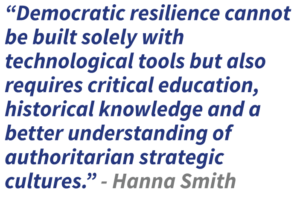
Hanna Smith, senior strategic advisor to the secretary general of the Organization for Security and Co-operation in Europe (OSCE) and former director of research at the European Centre of Excellence for Countering Hybrid Threats, emphasized Europe’s vulnerability and the changing times. She said that a long period of open and transparent knowledge sharing, which she described as a “time of openness” but also of a certain degree of “innocence”, has evolved into a new stage in which the security of knowledge has become a key issue because universities, curricula, academic networks and information flows can also be the subject of attack, manipulation and instrumentalization. Citing cyberattacks against universities with not only technical but also cognitive consequences, she argued that democratic resilience cannot be built solely with technological tools but also requires critical education, historical knowledge and a better understanding of authoritarian strategic cultures, concluding that “society’s resilience comes from elsewhere.”
16.00h
Welcome and Registration for attendees
16.30h
Event introduction
Opening Speakers
Joan F. Corona, President, Institute of North American Studies Foundation
Lia Miller, Consul General, Consulate General of the United States in Barcelona
Manuel Szapiro, Head of Representation in Barcelona, European Commission
16.45h
Opening Remarks
Pol Morillas
Director, CIDOB (Barcelona Centre for International Affairs)
17.00h Panel 1
Adapting the Alliance for a New Era
This panel will address potential strategic futures for NATO as Allied leaders prepare for Ankara 2026. Key questions include whether the Alliance will continue to expand, consolidate its current posture, or evolve in new ways. With larger defense budgets, what types of military forces will the Alliance invest in? Will NATO’s nuclear posture change given recent developments with the Russian nuclear arsenal? The discussion will also explore whether concerns about a reduced U.S. role in European security remain justified or whether recent transatlantic engagement suggests a more stable long-term trajectory. The panel will also address large-scale threats to NATO and how allies are likely to deal with them. These include NATO’s role supporting Ukraine both before and after an eventual ceasefire is achieved, and how it deters aggression from a reconstituted Russian military.
Speakers
Oana Lungescu
Distinguished Fellow, RUSI (The Royal United Services Institute for Defence and Security Studies).
Paul van Hooft
Research Leader, Defence and Security, RAND Europe.
Jonathan Sherry
Historian and Senior Editor at Eagle Intelligence Reports.
Chair
Lluc Vidal
Associated Professor, Political science and international relations, Universitat Oberta de Catalunya (UOC),
Questions & Answers
Coffee break
18.40h Panel 2
Enduring and Emerging Security Challenges
In addition to the threat posed by an aggressive Russia, which looks certain to persist for years to come, the Alliance faces many other enduring as well as emerging security challenges. Instability across NATO’s southern neighborhood, as well as coercive behavior by actors such as North Korea and China, continues to test Allied cohesion. Hybrid threats – from cyberattacks and disinformation campaigns to drone incursions near critical civilian infrastructure – are growing in frequency and sophistication. At the same time, the Alliance will be obliged to adapt to the security threats that technological advances such as AI and Quantum technologies will present over the coming decades. Strengthening research security has become one of the most pressing emerging priorities, as Allies work to protect sensitive innovative ecosystems and ensure trusted collaboration across borders. This panel will explore the emerging security landscape, evaluate the effectiveness of current NATO responses, as well as speculate about the future prospects for NATO to secure its territory and citizens and what changes might be required to improve its prospects.
Speakers
Zach Carwile
Associate Director, The Texas A&M University System Research and Innovation Security and Competitiveness (RISC) Institute.
Hanna Smith
Senior Strategic Advisor to the Secretary-General, Organization for Security and Co-operation in Europe (OSCE)
Apostolia Karamali
Member of the cabinet of Andrius Kubilius, European Commissioner for Defence and Space.
Chair
Carme Colomina
Research Fellow on European Union, disinformation and global politics, Barcelona Centre for International Affairs (CIDOB)
Questions & Answers
Academic advisor: Dr Jeffrey Michaels, IEN Senior Fellow in American Foreign Policy and International Security, Institut Barcelona d’Estudis Internacionals (IBEI)
Languages
Simultaneous interpretation will be included.
Communication
The media will be informed of expert visits.
The event will be streamed.
In collaboration with:




Amb el suport de:
