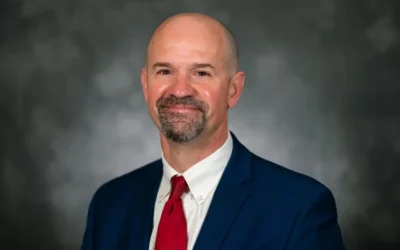
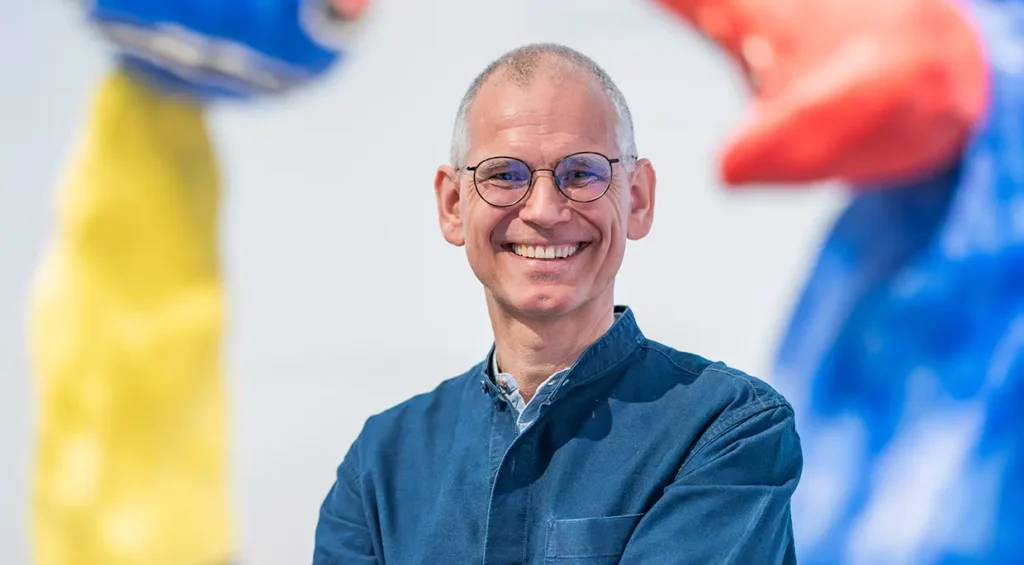
Marko Daniel, director of the Joan Miró Foundation and curator of the exhibition Miró and the United States. (Photo provided by the Joan Miró Foundation)

By Marc Amat
Until February 22, 2026, the Joan Miró Foundation is hosting the exhibition Miró and the United States, an exhibition that revisits the sustained link that Miró maintained with the artistic, institutional, and cultural context of the United States from the late 1920s and, especially, from his stay in New York in 1947. Far from being an isolated event, this transatlantic dialogue profoundly marked his work and positioned Miró as a reference point for several generations of artists in the United States, at a decisive moment for the configuration of modern art and abstract expressionism.
Within the framework of the 50th anniversary of the Foundation, we speak with Marko Daniel, director of the institution and curator of the exhibition, to delve deeper into this relationship and into the role that the United States played as a territory of creative freedom, exchange and opportunities for Miró.
What relationship did Joan Miró maintain with the United States throughout his career?
Miró’s relationship with the United States was long, intense and sustained over time. It begins in the late twenties, long before he physically traveled there, through exhibitions and through his gallerist in New York, Pierre Matisse. In fact, his first exhibition in a public museum took place in the United States, at the Brooklyn Museum, and not in Paris or Barcelona. In 1947 he took his first trip to New York, but this trip came after years of continued institutional and artistic presence in the country. From 1947, Miró would return several times and the United States would become his second most visited country after France, maintaining a constant dialogue with North American artists, museums and collectors for decades.
What did the United States represent for Miró?
 Above all, freedom and hope. He came from a Europe devastated by war and from a Spain marked by Francoist repression, by grey landscapes and by autarky. The United States represented a different world: color, openness, possibilities and creative freedom, but also freedom of thought and politics, which for him was fundamental. In addition, it offered him real opportunities to create, such as the studio he had in New York for a few months in 1947. It also provided him with an economic stability that allowed him to work with ambition during a difficult time. All of this turned the United States into a key space for his artistic and personal development.
How does the exhibition reflect this?
The exhibition reflects this by showing Miró’s relationship with the United States through very specific moments and connections: the first exhibitions in public museums in the United States, the retrospectives at the MoMA, the contacts with gallerists such as Pierre Matisse and, above all, the creative dialogues with artists such as Alexander Calder, Louise Bourgeois or the painters of abstract expressionism. The journey through the exhibition emphasizes exchanges, friendships and mutual influences, and shows how Miró not only influenced American artists, but also learned from them.
The exhibition talks a lot about 1947.
The trip of 1947 was decisive because it allowed him experience from within an artistic environment that until then he had only known at a distance. Miró spent seven months in New York, with his own studio, working intensively and coming into direct contact with artists, architects, musicians and poets. It was not an isolated stay, but a full immersion in the cultural life of the city: he visited studios, went to concerts, to the cinema, to the ballet, and shared ideas with creators of different generations. That experience strengthened his curiosity and his desire to continue experimenting, and consolidated a relationship with the United States that would never again be only institutional, but profoundly personal and creative.
What role did Alexander Calder and Josep Lluís Sert play as a gateway for Miró into New York?
 They were key figures. Alexander Calder was a very close friend of Miró and helped him integrate into New York cultural life. He introduced him to artists, spaces and diverse creative environments. They not only shared an artistic affinity, but also a personal relationship based on the constant exchange of ideas and works. Josep Lluís Sert, for his part, was a fundamental contact from an architectural and institutional point of view. Exiled to the United States after the Spanish Civil War, he held a position of enormous influence as dean of the Graduate School of Design at Harvard and facilitated, for example, commissions and projects that allowed Miró to work in public spaces in the U.S.
What relationship did Miró maintain with abstract expressionist artists, such as Pollock, Krasner or Rothko?
Miró was a fundamental figure for many abstract expressionist artists, especially from the MoMA retrospectives of the nineteen forties and fifties. Artists such as Jackson Pollock or Lee Krasner saw in his work a new way of understanding painting: a surface without a center, where gesture, rhythm and the distribution of forms extend across the entire canvas. The Constellations, exhibited in New York during the war, had a very strong impact and were described as “small miracles”.
Miró is often presented as an artist who never stops learning.
He had a constant curiosity and an enormous capacity to remain open to what younger artists were doing. When he was in the United States, far from situating himself as a consecrated master, he wanted to understand what was happening around him and how contemporary art was evolving. He observed with interest new ways of working, the use of gesture, the scale of pieces or the relationship with the body and space, and incorporated these experiences into his own practice. He maintained this attitude of permanent learning throughout his entire life.
The exhibition also places emphasis on American women artists of the period. Have these artists historically been overlooked?
 Yes. In New York, Miró related to artists such as Lee Krasner, Louise Bourgeois, Maya Deren, Len Lye or Louise Nevelson, who actively participated in debates and in the most innovative practices of the moment. Even so, many of them were left out of the official narrative of abstract expressionism. The exhibition seeks to make visible that this creative environment was not exclusively male and that Miró’s dialogue with the United States was also a dialogue with these artists, with their ways of working, of thinking about gesture, the body and the creative process.
How does the exhibition fit into the context of the 50th anniversary of the Joan Miró Foundation?
This exhibition reminds us that the Foundation was born out of an open and deeply international outlook, faithful to the spirit with which Miró understood art and the world. Miró conceived of the Foundation as a project for the future, intended as a continuing dialogue with the present time and with the generations to come. Miró and the United States shows precisely this attitude: the desire to remain open, to dialogue with other cultural contexts and to defend values such as freedom, hope and creative curiosity.