The IEN celebrates its 75th anniversary by reaffirming the importance of continuing to build bridges between the United States and Europe
The Catalan institution revives the Kennedy Prize and awards it to Joan Massagué, a world-renowned leader in cancer research
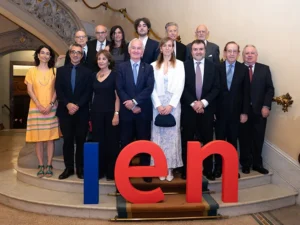
The Institut d’Estudis Nord-americans (IEN) celebrates its 75th anniversary by underscoring, more than ever, the importance of its existence. Founded in February 1951, during Francoism, the IEN has always been an institution committed to its time, attentive to change, and determined to lead initiatives aimed at disseminating, analyzing, and debating issues of pressing relevance. Without losing this spirit, the vitality of continuing to weave bridges between Europe and the United States remains one of the institution’s main objectives.
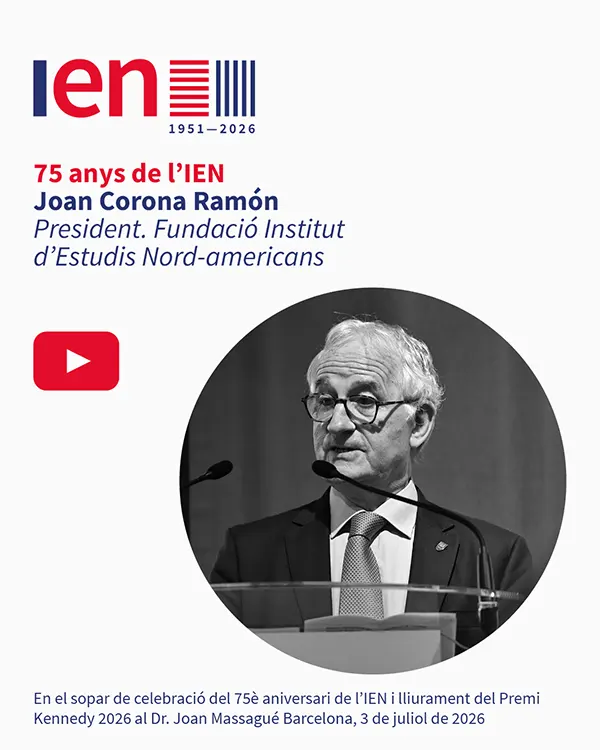
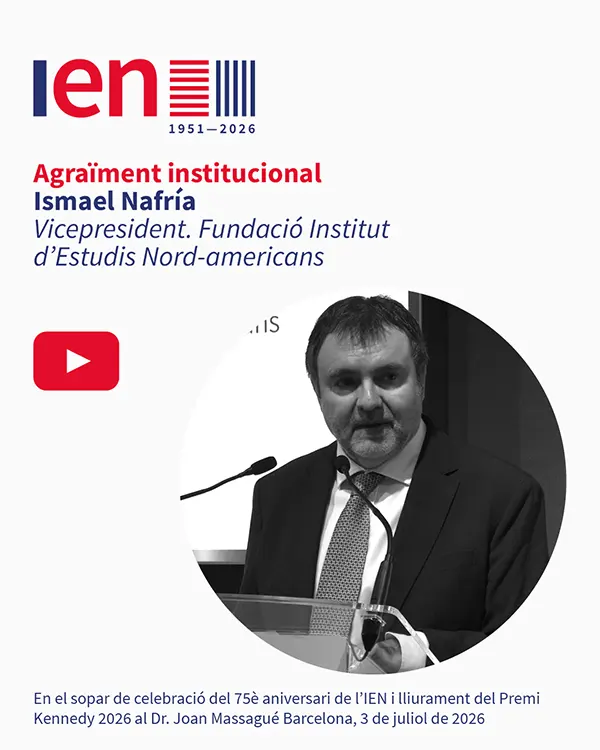
To understand political and global cycles, one must look at recent history. Joan F. Corona, president of the IEN, highlighted in his welcome remarks at the event held at the Círculo Ecuestre last Friday, 3 July, that the institution “was born from the vision and complicity of two friends: Dr. Josep M. Poal and engineer and architect Josep M. Bosch i Aymerich. Impressed by the cultural and scientific dynamism of the United States, they promoted a private, non-profit association which, under the first presidency of Josep M. Pi i Sunyer, would become an oasis of freedom and knowledge in Barcelona at the time.” He added that for decades, “the IEN was the leading private European institution dedicated to teaching English, with nearly 8,000 annual enrolments and more than 400,000 students trained,” accompanying the growth of several generations of Catalans. In this spirit, Ismael Nafría, vice president of the IEN, expressed his gratitude to “all those who gave life to everything the ‘Americà’ offered,” recalling that without them, the institution would not have reached this milestone.
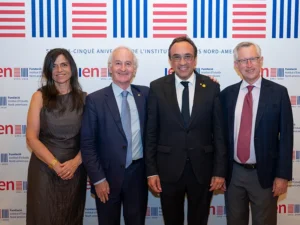
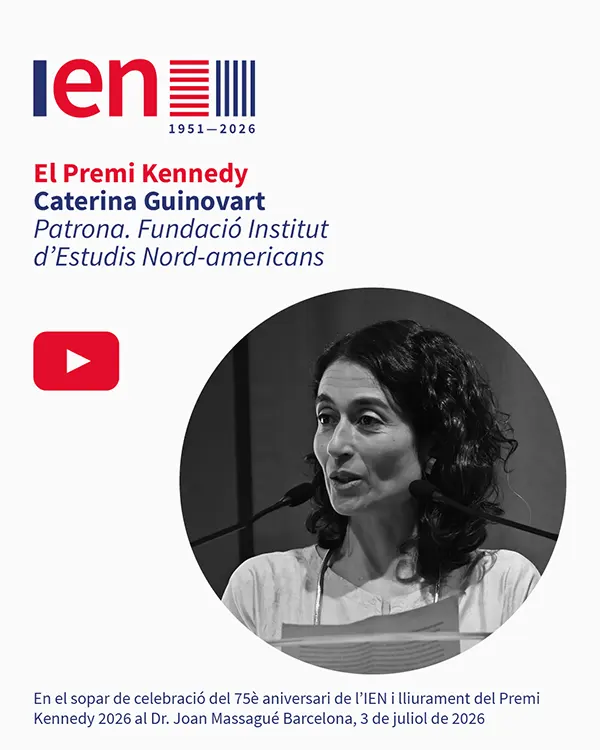
The IEN is an undisputed academic and cultural reference point, and throughout its history it has collaborated with the U.S Consulate General in Barcelona, the Government of Catalonia, the Barcelona City Council, and the Barcelona Provincial Council, forging partnerships vital to the cultural life of the country. All of this contributed to the institution being awarded by the Creu de Sant Jordi in 1992. For this reason, the institution’s cultural legacy permeated the entire evening, and guests were presented with the book El Món de Pau Casals, published by the IEN to mark its 75th anniversary The IEN awarded Pau Casals the Kennedy Prize in 1966. The Kennedy Prizes, first established in 1964, were created as part of the institution’s mission to serve as both a cultural bridge and an educational reference point, and have now been reinstated on such a symbolic anniversary. Caterina Guinovart, trustee of the IEN, recalled that “Pau Casals and John F. Kennedy shared a profound alignment in their defense of world peace, disarmament, and the freedom of peoples”. She added that “reviving the Kennedy Prize today is not an exercise in nostalgia, but a declaration of principles.”
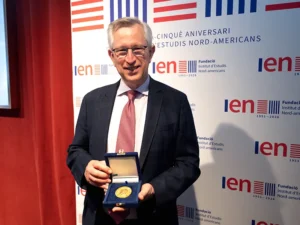
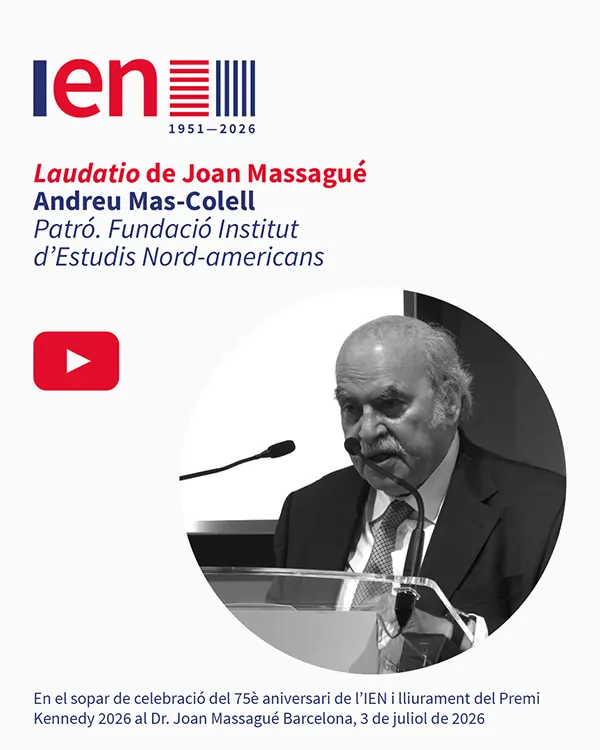
Building on the legacy of Maestro Casals—and of other distinguished past recipients such as Mr. Sargent Shriver, Director of the Office of Economic Opportunity in Washington D.C.; the Apollo XI crew, the first to reach the moon; Dr. Valentí Fuster, a world-renowned cardiologist; or Xavier Trias, mayor of Barcelona and the most recent awardee in 2014—the evening welcomed a new Kennedy Prize laureate: Joan Massagué, pharmacist, world-leading scientist, and pioneer in deciphering the biological mechanisms of metastasis in cancer. The recognition was preceded by a laudatio delivered by Andreu Mas-Colell, IEN trustee. The former Minister of Economy and of Universities and Research drew smiles from the audience when he admitted that he “boasts” of knowing Joan Massagué and that “it earns him points.” Turning to his formal remarks, he highlighted the awardee’s ability to shape scientific policy: “He receives it, too, for what he has done with this scientific eminence, for establishing a major bridge between the United States and Catalonia’s research ecosystem, and for strengthening it.”
Joan Massagué picked up on Mas-Colell’s words, expressing gratitude that “the IEN was a pioneer in a grey era,” and emphasized the importance of continuing to build bridges that foster relationships with the United States: “Young people continue to feel inspired by the U.S., which they see as full of opportunities.” He described his own experience as “the three segments that make up, in my personal case, the bridge: the initial excitement, the possibility to do and discover, and then the learning of how to manage institutions of this kind—segments that are also bidirectional.” He concluded by stressing the importance of protecting science and the institutions that make it possible, reminding the audience that although knowledge is built over decades, these structures are fragile. In this regard, he warned of the decline in support for science currently taking place in the United States and underscored that commitment to science must stand above political differences.
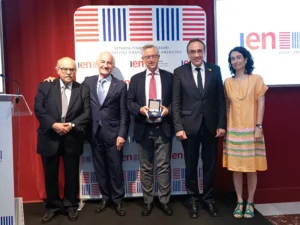
Benjamín León, U.S. Ambassador to Spain and Andorra, sent a message thanking the IEN for its collaboration with the consulate: “Thank you for contributing to a deeper understanding of our culture and society”. One of the most moving moments was the closing speech by the President of the Parliament, Josep Rull, who described the event as a “luminous moment that strengthens collective self-esteem” across society. He highlighted “the strength that Catalan society has always had,” and praised Joan Massagué and the significance of the Kennedy Prize, stating: “Nations need role models, people who inspire deep admiration, respect, and inspiration. Joan Massagué embodies precisely this profile.” Referring to the United States, he evoked its power of inspiration through the legacy of Joseph Nye: “Great powers do not lead only because they are stronger. They lead, above all, because they can inspire.” He concluded with a reflection on hope and the building of bridges between peoples, thanking the Institute with words that evoked the legacy of Pau Casals, one of the first Kennedy Prize recipients: “Thank you for building this bilateral bridge—this bridge of emotion, knowledge, science, literature, and culture—and above all for ensuring that what Pau Casals said, that humanity’s aspiration to embrace peace and hope, never fades.”
Watch the Video Recap
View the Photo Album
Speeches