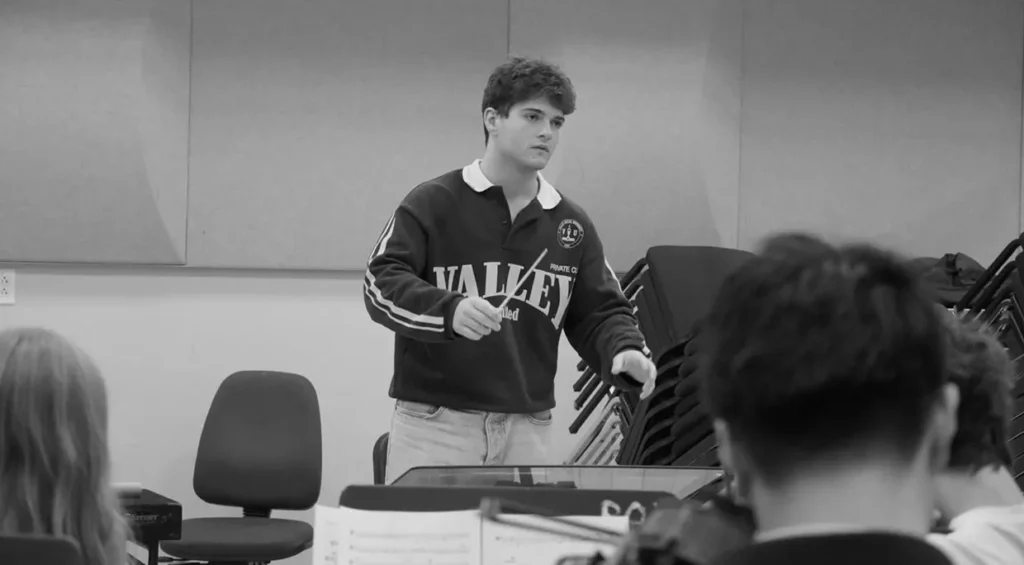
Film Scoring student at Berklee College of Music, in Boston, and former member of the IEN Competitive College Club (CCC)

By Marc Amat
In the United States there are more than 4,000 universities across the country. However, gaining access to them is not easy. The admissions system is completely different from that of Catalan universities: there is no cutoff grade. Instead, institutions assess aspects such as the student’s profile, their interests, their previous background and how well they fit with the type of talent the university wants to attract. To make it easier for Catalan students to study in the United States, IEN hosts the EducationUSA program, an official network of the U.S. Department of State that offers academic guidance to international students who want to take that step.
One of the key tools of the program is the Competitive College Club (CCC), a space that provides continuous guidance for two years to students while they are in their final years of secondary school. During this time, they work on preparing the strongest possible application to US universities. Currently, the application period to join the CCC 2026 is open. Anyone interested can write to barcelona@educationusa.org.
This month, we talk with Pau Rib a, an 18-year-old student of Film Scoring at Berklee College of Music in Boston, who was part of the Competitive College Club at the Institut d’Estudis Nord-americans in Barcelona. He explains how his academic and personal experience in the United States has been so far.
What led you to study music in the United States?
Music has always been very present in my life: I started with the piano when I was four years old and, from a very young age, I was clear that it was what I wanted to do. I really like music and also cinema, so studying music for film was a natural way to combine these two passions. Studying in the United States is helping me grow a lot both professionally and personally.
When did you decide you wanted to take the step of going abroad to study?
It was not an immediate decision. At first I was afraid to leave, because all my friends were staying here. But over time I understood that, for the type of studies I wanted to do, going abroad was almost essential. It was a long process of mental preparation, almost two years, which helped me a lot to take the step calmly. Here there is no specific degree in film scoring. There are courses and short-term training options, but not a university pathway like the one offered by some universities in the United States. I knew that there were very specific and specialized options there, and that’s why I decided to look directly abroad.
How was the admission process to U.S. universities for you?
 It is a very complex process and very different from the one here. There is a lot of bureaucracy, many essays, deadlines and requirements. Honestly, I think I could not have done it alone. You need someone to help you structure yourself and understand what each university is asking of you in each moment.
You went through the whole process accompanied by the IEN Competitive College Club (CCC). How did it go?
It was key. Through the CCC we had very personalized follow-up, with meetings every two weeks and also individual guidance. They help you understand what you have to do, what you are missing, how to improve the essays and how to approach each application. During a very stressful time, this support gives you order and confidence.
What was the most difficult moment of the whole process?
Seeing the deadlines approaching and still having many things left to do. The workload is large and it’s very hard to combine it with school and music studies. But once it passes, you see that all the effort was worth it.
What main differences have you noticed between the U.S. university system and the Catalan one?
The biggest difference is the approach. Here learning is much more practical and oriented towards real projects. It is not so much about passing subjects as about building your own path: what counts is what you do, who you work with and what projects you develop throughout the degree. You have a lot of freedom to explore, to collaborate with other students and to combine disciplines. You can work with musicians, but also with students of production, cinema or music business. This creates a very rich environment and one that is very connected to the professional world.
Is that environment very different from what you find in Catalonia?
 In the United States you have access to recording studios, to musicians to collaborate with and even to orchestras to perform your compositions. You can record, give concerts and put your ideas into practice almost immediately. In Catalonia, this is much more difficult. In terms of how demanding it is, it is not an especially difficult degree to pass, but that doesn’t mean it is easy. The degree itself is not worth much on its own: what really matters is what you have done beyond the classes. That’s why you need to look for projects, concerts, collaborations and extracurricular experiences from day one.
And is there a lot of competitiveness among students?
Not especially. Obviously, everyone wants to do well, but the atmosphere is very collaborative. Unlike some more traditional environments, here people help each other a lot. More than competing with each other, everyone tries to improve themselves. The contacts you make at university are key and can open many doors for you in the future. In fact, you come out much better positioned for the U.S. job market than if you had not studied here and just came to look for work.
What is life on campus like? How have you integrated?
Life on campus is very active. There are always activities, concerts, rehearsals or new proposals to take part in. This makes you integrate very quickly. You meet people from all over the world and live with very different cultures, which forces you to open your mind and learn to relate to very diverse people. In addition, you always end up finding someone from Catalonia. There are Catalans all over the world, also in US universities, and that helps you feel a little more at home.
What is your daily life like as a student?
 It depends a lot on the projects I have at any given time. I have set classes like piano, harmony, music business or introduction to film scoring, but also many rehearsals and practical assignments. In addition, there are often concerts or parallel projects that arise almost spontaneously. On campus everything is very concentrated: classes, residences, rehearsal spaces, social activities. This means you make friends right away and you don’t have much time to miss home. At first, it’s hard to say goodbye to your family, but in a few days, you are already immersed in the campus dynamic.
How do you imagine your future once you finish your degree?
I am not completely sure yet. The job market in the world of cinema and music is very broad and I don’t know where work will take me. What I do know is that the experience and the contacts I am making here will be key, whether I stay in the United States or return at some point.
What advice would you give to a student who is considering studying in the United States?
That they look into it in advance and don’t leave it until the last minute. If they are clear about what they want to study and know that in the United States there is more specific training or more opportunities, they should dare to take that step. In the end it’s an experience that has a big impact on your personal and professional life. In addition, the CCC is a free service that offers very personalized support. They guide you through the whole process, help you with essays, deadlines and decision making. Honestly, I would have paid for the service they gave me.
And to families, what would you say?
That they shouldn’t be afraid. Their children don’t disappear: you keep in touch a lot, you come back home for holidays and long weekends, when possible. The experience is very worthwhile and will really help them grow a lot.